Saturday, November 9, 2013

Thanksgiving- A look into the 19th Century meal!

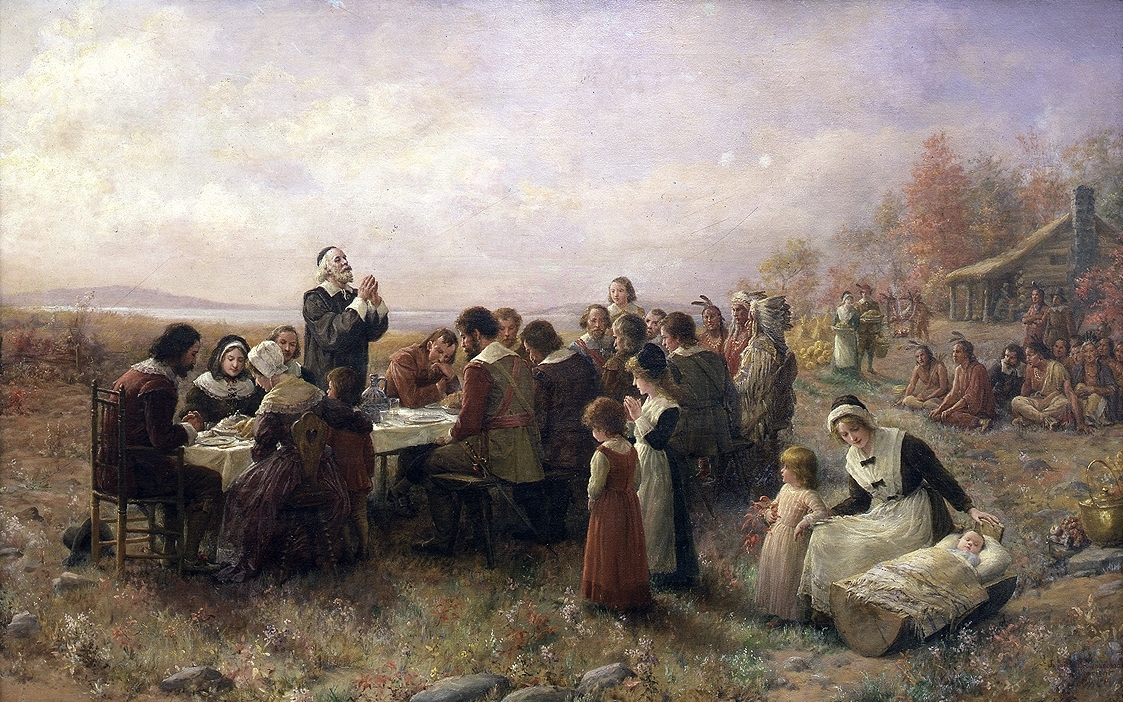
"The First Thanksgiving at Plymouth" Jennie A. Brownscombe, 1914
     Once a year we all sit down and enjoy a great feast with our friends and family in November. This national holiday is often a time to be grateful for all that we have. In recent years however, it has become cluttered with the stress of setting the meal out on a massive table topped with manicured centerpieces and the looming cloud of Black Friday shoppers. The images of Pilgrims & Indians dance in our heads as we sit down to eat the traditional meal of Turkey, dressing, potatoes, cranberry sauce, and pie- you know just what they had in 1621! Okay, so maybe I am painting a false picture. Let's take a look back.
     Thanksgiving was made a national holiday in 1863 by Abraham Lincoln, not 1621! We have one lady to thank- Sarah J. Hale. While Thanksgiving had been celebrated sporadically before the 1863 proclamation, it was not an annual occurrence. Hale had lobbied for years to get a day for national Thanksgiving, in the midst of the Civil War, after the victories in Gettysburg & Vicksburg, Lincoln conceded and made the proclamation for an annual national holiday.
     Traditional foods have been served for centuries, but where our "menu" comes from is a bit sketchy. I would assume that a lot of the first thanksgivings used what was available, usually meaning wild game & seasonal vegetables. Some of the first "pilgrims" list fowl, venison & fish for the meal, and not much else is mentioned. It could be that the sides were a common staple and not worth the mention.
     When Sara J. Hale wrote Northwood in 1827 she included an entire chapter about the Thanksgiving Meal, giving detailed information about the food that was included- with the turkey taking the center stage. She also references a chicken pie that should be as large as the host's gratitude for the party. Another reference to a Thanksgiving menu can be found in Buckeye Cookery in 1877.


     You can see that many of our traditional favorites are mentioned including roast turkey, baked sweet potatoes, macaroni & cheese, and  pumpkin pie!   There are other references to what should be served at a Thanksgiving meal that include chicken pie, pork loin, pickles & sweetmeats! There seemed to be a lot of variety in the meal, much like there is today from table to table.
     Meat pies were common in the 19th Century, as I have tried on here, there are many varieties for each meat pie, chicken, pork, mincemeat, etc. the possibilities seems almost endless. The chicken pie seems to be a staple on the 19th century kitchen table. Sara Hale describes a simple pie made from the best parts of the chicken then flavored with butter & put into a puff paste- like a pumpkin pie. The dish below taken from  Jennie June's American Cookery Book, 1870 is more complex- including three meats & boiled eggs.

Roast turkey- the center piece of every meal- including a nice stuffing & gravy from the  Practical Cook Book-1850. Suggested sides include boiled ham & cranberry sauce.

Cranberry sauce is often served with roast turkey & other fowl.
Directions for Cookery, in Its Various Branches- 1844
The side items seem to be an endless list of potatoes, squash, salads, pickles, breads, and relishes. Almost any in season vegetable could be dressed and sent to the table to accompany the meats.

Desserts were plenty to chose from as well- the lists of cakes, pies and puddings could meet the need of any sweet tooth.
There are many- almost too many- reference to pumpkin pies & puddings- check out this post for pumpkin goodies.
 Indian Pudding- a dish made with corn meal and molasses- was an item most tables had seen throughout the year, and of course was brought out on Thanksgiving as well.
Directions for Cookery, in Its Various Branches, 1844
Mince pies are often thought of as a traditional Christmas dish but seemed to have been served around Thanksgiving as well. This is a common recipe combining beef & apples with raisins and spices to make a great savory pie!
The New England Economical Housekeeper, 1845
So on this Thanksgiving, sit aside the Sales ads & the Christmas ornaments & make a delectable meal for the family- enjoy it with the ones you love! Maybe take the time to read Thank You, Sarah: The Woman that Saved Thanksgiving ! Remember, Thanksgiving would not be the holiday that it is today without a great influence from the 19th Century!

Thursday, November 7, 2013

Plain Family Dinners for November

Another menu for great November dinners!! They look great, although I think I will skip the stewed Eel!

How to Dine, Dinners & Dining, Isabella Beeton, 1866

Coming soon, historic references to your Thanksgiving favorites!

Tuesday, October 22, 2013

A Rainy Day with Great Friends!


Saturday started gray & rainy. It was a great window into the past, since I could hardly see anything in the dark kitchen that morning, even with the fire going.  I had chosen to make Eliza Leslie's "To Stew Beef".
I had a pretty large hunk of beef too! It was put in the pot early, around 9:30am & covered with water.
It was great to have fun in the kitchen with some of my dearest friends! We mostly enjoyed watching the kids run around in the morning, in the midst of peeling potatoes & cutting carrots. 
Morning fun in the Kitchen

 The day turned out to be busy, despite the gray skies, and periods of light rain. Visitors could take wagon rides, play period games of townball, tour the Harper House, or visit with us in the demonstration area.
Speaking to visitors about period cookery. 
 The stew turned out wonderfully!! The broth was some of the best I had ever tasted, I had only seasoned the stew with salt & some kitchen pepper!  I cooked some carrots & onions on the side, but I added them into my bowl of wonderful beef!  There was also fresh bread & butter to go along with the wonderful meal!
A Stew of Beef


The girls playing

All of the toys neatly lined up on the well. 
For even more photos of the event: http://www.newsargus.com/gallery/main.php?g2_itemId=749175

Tuesday, October 15, 2013

To Stew Beef

I always get excited when I get to cook on an open fire! It's something about the cool air, the crackle of the fire, the smell of cider! The fact that fall is my favorite season probably has a lot to do with it as well.  
This year for Bentonville's Fall Festival (yes, I have the best job) I will be cooking once again in our lovely kitchen. I have decided that a meal of "Stewed Beef" with some veggies is perhaps one of the most wholesome meals I could make & all of those veggies are so pretty sitting in baskets waiting to be cut up!

I have pulled a few different receipts from the books. I am sure that I will be following one of them this weekend! Stay tuned to see the finished meal! 

"Directions for Cookery, in its Various Branches" Eliza Leslie, 1844


"The Frugal Housewife: or, Complete Woman Cook" Susannah Carter, 1796


"The Kentucky Housewife" Lettice Bryan, 1839


Wednesday, October 2, 2013

Kitchen Pepper

In order to get our period food to taste like it would have 100 years ago we need to season it like it was 100 years ago!  I have found that I have much more nutmeg in my cabinet than ever before, and I bought mace for the first time in my life- all because of period cookery.  This "recipe"  is a blend of spices to use in period kitchens. It comes from The Kentucky Housewife, 1839. 
This blend was pretty easy to put together, and I had everything already in the cabinet (except white pepper, which I grabbed from the Food Lion).   I threw everything into my mortar & pestle. The good thing about modern spices is that most of them are already ground up, making the work a little easier. The instructions say to use 12 blades of mace; mine was already ground, so I used about a tablespoon.  
Mix it together well with the mortar & pestle-it does become a nice fine powder. 
Kitchen Pepper mixed together. 
This does make quite a lot of seasoning.  I had extra that did not fit in by bottle. The extra was put in a modern spice container to use in my kitchen.  This is a spice that does have some heat to it. I am not one that likes hot & spicy foods, and this may be used sparingly in my kitchen. However, I do see where it will enhance the flavor of gravy & I can't wait to try it!

Bottled & Corked!
There is a reference to this pepper in another recipe in the Kentucky Housewife. It is one of the spices found in "Bread Sauce for a Pig".  It only calls for a teaspoon.


Enjoy! 

Tuesday, October 1, 2013

Aren't you hot in that? Pt. 2

Here are a few more period reference images of "working women". Notice all that their clothes have in common. Rolled-up sleeves & pinned up skirts!  Enjoy! 

The Sinews of Old England  George Edgar Hicks - 1857   Private collection   Painting - watercolor
"The Sinews of Old England" George Edgar Hicks, 1857
I have always loved this image. Although this particular one is from the outside looking in, we can see that this couple is probably just outside of their kitchen judging by the cupboard of dishes that can be seen through the door. 
"Rustic Courtship" Harpers c.1865
"Rustic Courtship" Harpers, c. 1865
Lilly
"The Jolly Washwewoman", Lilly Martin Spencer, 1851
I just love all of the details that Lilly Martin Spencer includes in her paintings. They are like the snapshots of the 19th century! 
"Girl in a Brown Dress" Joshua Cristall (1768-1847), undated
I was so happy to find this image!! You can see how the skirt looks from the back!


Friday, September 27, 2013

Aren't you hot in that?


  There are upsides & downsides to historic cookery. I get to produce some of the best food that I have ever tasted, but I have to do it over a hot fire. A majority of us that do historic cooking demonstrations do so over open hearths in historic kitchens or in fire pits outside. Unless its really cold outside, the answer is yes, I am hot. But, I do so for my own safety. Very rarely do I cook when I am not "in costume", meaning I am fully dressed from the 19th century. Chemise, drawers, corset, petticoats, dress, apron, stockings, boots. Yes, 8 pieces of clothing, and yes it does get hot, but like food, I want to do it right. But sometimes, it can be hazardous with big skirts around open fires.


Fire safety is a real issue. There is always the threat of flames catching skirts at just the wrong time. In our historic kitchen at work we keep fire extinguishers nearby, in camps there are always buckets of water just in case. Some of the ways we can help keep such a thing from happening is to look at images from the past. 
"Shake Hands" Lilly Martin Spencer

CDV C. 1860s

What do we notice from both of these images? Both are ladies are in kitchen settings from the mid-19th century. They are wearing their clothing in a similar manner. We see that the skirt of the dress is pulled up and pinned/tucked behind the body (even the baby in the CDV, just like mom!).Pulling the skirt up has revealed that these ladies are wearing a "work petticoat", or a petticoat that is not white, probably made of wool. Both wearers have also shortened their sleeves. It is unclear in the Spencer painting if the sleeves are pushed up or indeed short sleeves like those seen in "Kiss Me and You'll Kiss the Lasses". In the CDV it is obvious that "mom" has unbuttoned her sleeves and pushed them up out of the way.  One thing we cannot really tell from these images is that "work" dresses usually had shorter skirts so that feet did not get tangled up in the hem.  This  look can be easily replicated.

Photo Credit: Leslie Macon

If you will be cooking on an open fire, I strongly recommend a wool work petticoat & a wool work apron. Wool will smolder rather than catch the flame. There are constant reminders in living history circles about the importance of natural fibers. Not only are they accurate, but they are safer. Modern fibers such as rayon and polyester burn quicker than cotton, linen & wool. Chemically enhanced fabrics also melt, and can melt to the skin causing worse injuries. No fabric itself is fire retardant, so be careful with whatever you wear. 


Want more:  Part 2  Part 3